
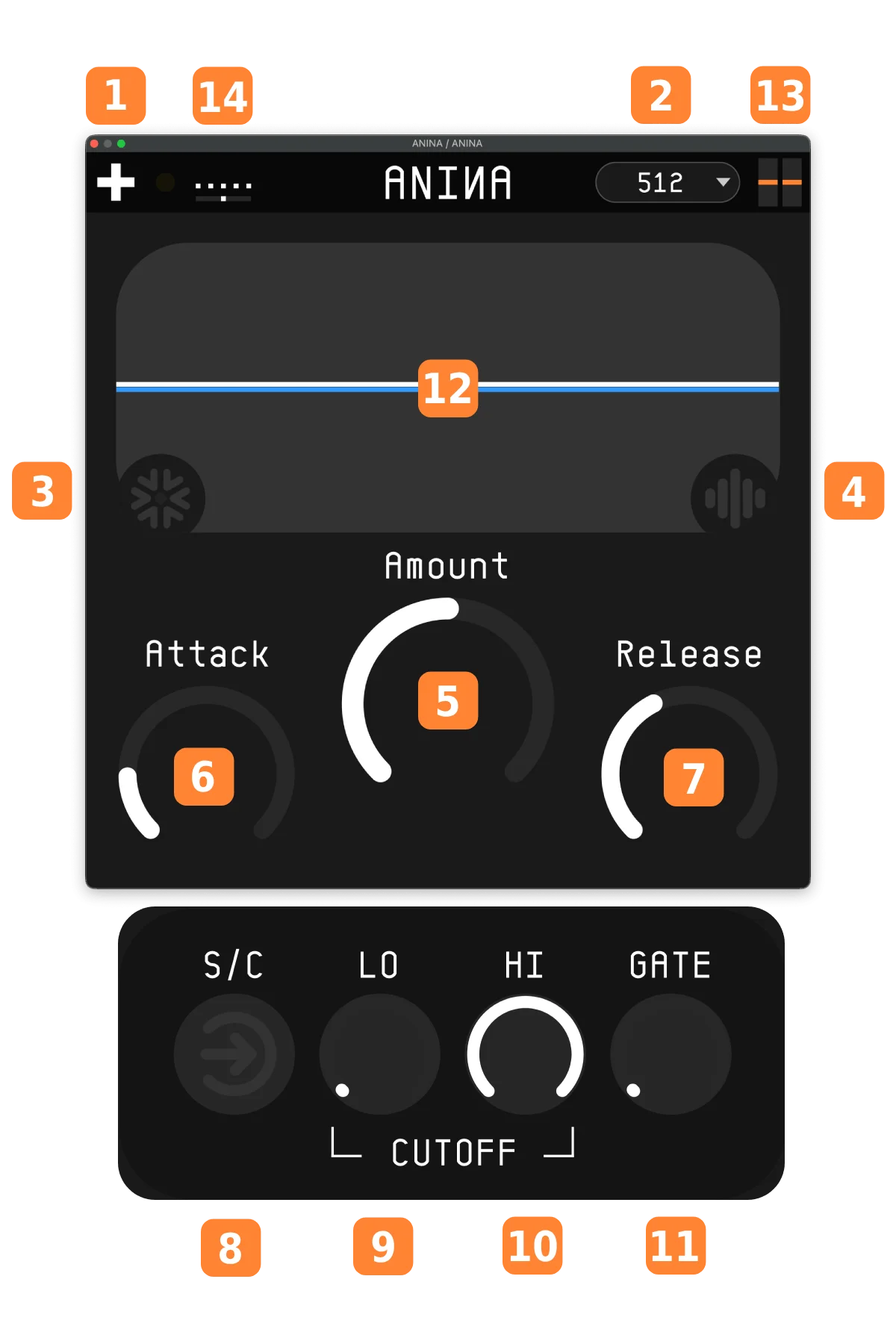
ANINA
Key Features
- Spectral processing works across at least 256 bands, giving ANINA more selective resonance control than broad EQ cuts or standard sidechain compression
- Sidechain mode can carve out room for another source only when needed instead of applying static tonal changes
- Freeze function locks the current compression spectrum so you can study or creatively hold a spectral shape in place
- Delta monitoring lets you hear only what the plugin is removing, turning resonance suppression into a sound-design tool
- Block-size control trades tighter response for higher frequency resolution depending on the material you are processing
- Version 1.1 added input and output gain plus a built-in Tilt EQ on the compression signal for more detailed shaping
Description
ANINA is a spectral resonance suppressor from CRQL that is designed to create space in a mix without relying on conventional broadband sidechain compression or ordinary EQ moves. It works by applying spectral processing across hundreds of bands, so the plugin reacts more selectively to buildup than a standard compressor or static notch filter can.
That makes it useful as both a cleanup tool and a creative processor. The core controls handle amount, attack, release, block size, and low or high filter cutoffs, while the sidechain mode lets you carve room for another source only when that source actually needs the space.
ANINA also has a more experimental side that keeps it from feeling like a narrow mix utility. Freeze locks the spectral curve in place, Delta lets you monitor only what the plugin is removing, and CRQL explicitly frames it as both a resonance suppressor and a resonance isolator for sound-design use.
BPB compared its intent to Trackspacer and noted that it improves on Florah Lite by shipping as a normal plugin instead of requiring Plugdata. That matters because the current release runs on Windows, macOS, and Linux in VST3, CLAP, and AU formats, which lowers the barrier for producers who wanted this style of spectral shaping in a more direct workflow.
The main caveat is that spectral processing brings its own quirks. CRQL notes an average latency of about 11 ms plus the possibility of subtle pre-ringing or transient changes, but if you can work within that trade-off, ANINA offers a surprisingly deep way to solve harshness, masking, and even strange resonance-focused sound-design tasks.
Frequently Asked Questions
Is ANINA only for mixing, or can it be used creatively?
It can do both. CRQL positions it as a resonance suppressor, but the Freeze and Delta controls make it useful for sound design as well, especially when you want to isolate or exaggerate what the spectral engine is removing.
How is ANINA different from Florah Lite?
BPB frames ANINA as an overall improvement and specifically highlights that it does not require Plugdata. That means you get a more conventional plugin workflow while keeping the same general idea of spectral, space-making processing.
Does ANINA introduce latency or artifacts?
Yes, some latency is part of the design. CRQL states that spectral processing introduces about 11 ms of average latency and also warns that you may hear subtle pre-ringing or small changes in timbre and transients depending on the settings.
Which plugin formats and operating systems are supported?
ANINA is available for Windows, macOS, and Linux. The current release supports VST3 and CLAP across all three platforms, with AU additionally available on macOS.


