
Argotlunar

Key Features
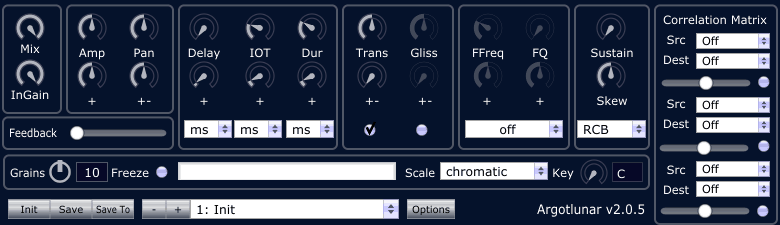
- Real-time delay-line granulator that splits incoming audio into grains with independent amplitude, panning, duration, delay, pitch, glissando, filter, and envelope controls
- Parameter correlation matrix for linking grain properties to each other, such as mapping filter cutoff to pitch or grain duration to stereo width
- Tempo sync for all time-related parameters, enabling rhythmic pulsing textures locked to your DAW's BPM
- Pitch quantization to specific chords and musical scales for harmonically controlled granular processing
- Feedback path that routes grain output back into the input for densely layered, evolving, and chaotic sound design
- Comb filter and freeze delay buffer for additional tonal shaping and sustaining captured audio fragments
- Open-source codebase (GPL v2) with cross-platform support across Windows, macOS, and Linux
Description
Argotlunar by Michael Ourednik is a real-time delay-line granulator designed for surreal audio transformations. It captures an incoming audio stream and disintegrates it into short fragments called grains, each with independent random settings for amplitude, panning, duration, delay, pitch, glissando, filter cutoff, and envelope shape.
The plugin's most distinctive feature is its parameter correlation matrix, which lets you link different grain properties to each other. You can map higher filter cutoffs to grains with higher pitch, or pan shorter grains to the center while spreading longer ones wide across the stereo field.
Time-related parameters sync to your DAW's tempo for rhythmic pulsing textures, and pitch parameters can be quantized to specific chords and musical scales. This combination of tempo-locked timing and harmonic quantization gives Argotlunar a surprisingly musical character that goes well beyond typical random granular effects.
The feedback path routes the mixed grain output back into the input, building chaotic, densely layered textures that evolve over time. Users on audio production forums praise this feedback loop as one of Argotlunar's strongest creative tools for generating complex evolving soundscapes from simple source material.
Argotlunar is open-source software licensed under GPL v2 and runs on Windows, macOS, and Linux in both 32-bit and 64-bit versions. It supports VST and Audio Units formats and is built with the JUCE framework.
Video Preview


Frequently Asked Questions
What makes Argotlunar different from other granular plugins?
Argotlunar's standout feature is its parameter correlation matrix, which lets you link different grain properties together in ways most granular effects cannot. For example, you can make higher-pitched grains automatically have a brighter filter cutoff, or make longer grains spread wider in stereo. This interconnected approach creates complex evolving textures that would require extensive modulation routing in other plugins.
Can Argotlunar produce rhythmic or musical results, or is it purely random?
Both. While the randomized grain parameters excel at experimental textures, Argotlunar's tempo sync locks time-related parameters to your DAW's BPM for pulsing rhythmic effects. The pitch quantization constrains grain pitches to specific chords and scales, so you can create harmonically coherent granular textures rather than atonal noise.
Does Argotlunar work with Linux?
Yes, Argotlunar supports Linux with both 32-bit and 64-bit VST builds. Linux users should install the ttf-bitstream-vera fonts package for the interface to display correctly. The source code is also available on GitHub under GPL v2, so you can compile it yourself if needed.
How does the feedback function work in Argotlunar?
The feedback path takes the mixed output of all grains and routes it back into the granulator's input buffer. At lower settings this adds subtle layering and depth, while higher feedback amounts create increasingly chaotic, densely textured, and distorted sounds as grains continuously feed back on themselves.


