
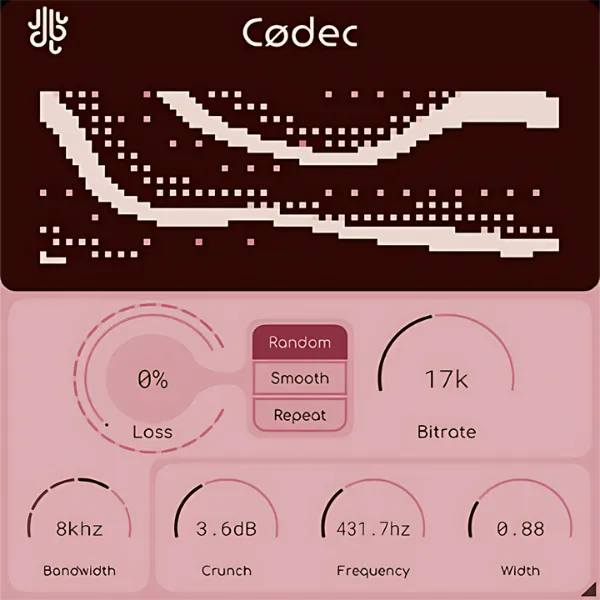
Codec

Key Features
- Real-time internet audio codec simulation that compresses and decompresses your signal using algorithms designed for voice communications
- Packet Loss system with three modes (Random, Smooth, Repeat) to simulate poor internet connections at adjustable drop rates
- Packet Disorder control shuffles audio packet order for glitchy, unpredictable textures with a buffer of up to 25 packets
- Adjustable Bitrate from 2 kbps to 32+ kbps with increasingly severe compression artifacts at lower settings
- Colored Noise module injects gated noise before encoding, adjustable from brown (low frequencies) to white (high frequencies)
- Crunch section applies massive gain to specific frequency ranges pre-encoding, then filters it out post-decoding for distortion without volume increase
- Voice and Music algorithm modes respond differently to incoming material, with Bandwidth selection from 4 kHz to 20 kHz
Description
Codec by Lese is an audio degradation plugin that simulates internet audio compression in real time. Unlike traditional lo-fi tools that emulate vinyl or tape, Codec uses an actual audio codec algorithm designed for internet voice communications to compress and decompress your signal inside the DAW.
Version 2.0 introduces three major additions: Packet Disorder randomly shuffles incoming audio packets for chaotic, glitchy textures; a Noise module injects colored noise before encoding to produce messier artifacts; and an enhanced Crunch section lets you shape distortion by hovering over the visualizer. These join the original controls for Loss, Bitrate, and Bandwidth.
The Loss system simulates a poor internet connection by dropping audio packets at a user-defined rate. Three loss modes are available: Random drops packets unpredictably, Smooth ramps the probability gradually, and Repeat reuses the last packet when loss occurs.
Reducing Bitrate below 32 kbps introduces clearly audible compression artifacts, while the Bandwidth selector caps the frequency range from 4 kHz to 20 kHz. An Algorithm switch toggles between voice-optimized and music-optimized codec modes, each responding differently to incoming material.
The Dry/Wet mix control includes automatic delay compensation matched to the codec's processing latency.
BPB reviewer Tomislav Zlatic describes Codec as one of the few plugins that authentically recreates early 2000s MP3 artifacts, calling it ideal for vaporwave, dreamcore, and nostalgiacore genres. Reddit users across r/FL_Studio and r/audioengineering consistently recommend it as the go-to solution for simulating low-quality MP3 and streaming audio.
Codec v2.0.4 is available for Windows (VST3, AAX) and macOS (VST3, AU, AAX) with Intel and Apple Silicon support. The interface is fully vectorized and resizable.
Video Preview


Frequently Asked Questions
What is a codec plugin?
Codec is an audio effect that uses a real internet voice compression algorithm to degrade sound in your DAW. Instead of emulating analog artifacts like vinyl crackle or tape hiss, it simulates the digital compression used in streaming audio and VoIP, producing aliasing, bandwidth limiting, and packet loss artifacts.
What is the difference between Codec's Voice and Music modes?
The Algorithm switch toggles between a voice-optimized codec (the default) and a music-optimized codec. The voice mode is tuned for speech frequencies and produces more aggressive degradation on musical content, while the music mode preserves a wider frequency range. Switching causes a brief audio cutout as the codec reinitializes.
How does Packet Disorder differ from Packet Loss in Codec?
Packet Loss drops audio packets entirely, creating gaps or repeated fragments depending on the selected mode. Packet Disorder instead shuffles the order of packets in a buffer of up to 25, so all audio data is still present but arrives out of sequence. Disorder produces a more chaotic, stuttering effect rather than the dropouts of Loss.
Does Codec introduce latency in my DAW?
Yes, the audio codec processing adds a small amount of latency. Codec includes a built-in Dry/Wet mix control with automatic delay compensation that aligns the dry signal with the processed signal, so parallel blending stays phase-coherent.


