
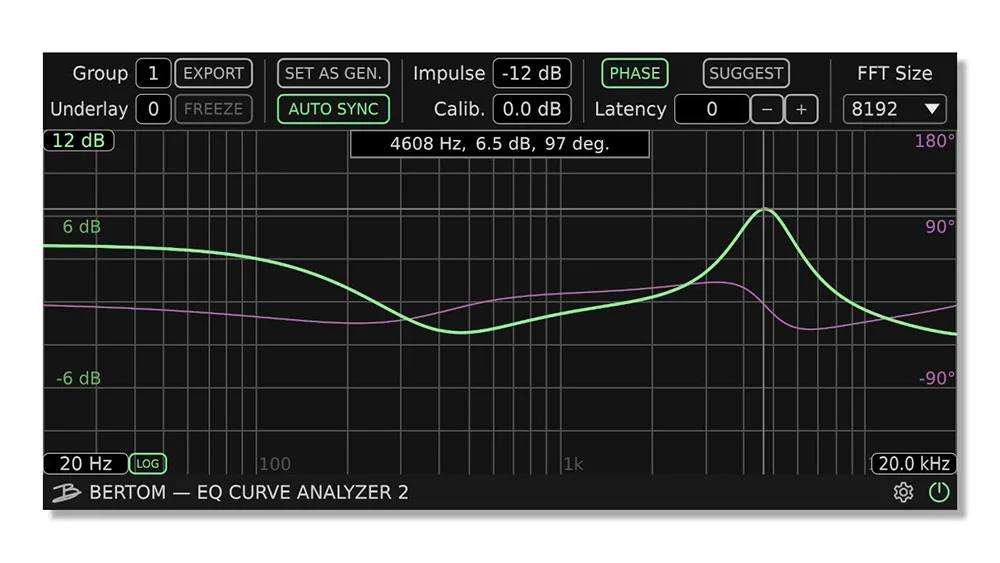
EQ Curve Analyzer v2.0.0

Key Features
- Measures the exact frequency response (magnitude and phase) of any plugin or hardware device placed between two instances
- Real-time group comparison system overlays two analyses on the same graph for instant A/B evaluation of different processors
- Built-in signal generator eliminates the need for external test tone files or routing workarounds
- Educational tool for studying how classic EQ emulations, saturators, and compressors color audio under the hood
- Available in VST3, AU, and AAX formats with native Apple Silicon support on macOS
- Pay-what-you-want pricing with no account registration or email gate required
Description
EQ Curve Analyzer by Bertom Audio is a plugin analysis tool that reveals the exact frequency response and phase behavior of any other plugin or hardware unit in your signal chain. It works by placing two instances around the device under test: one generates a test signal and the other measures what comes out.
The v2.0 update introduced a group comparison system that overlays two analyses on the same graph in real-time. This makes it straightforward to compare how different EQ plugins handle the same curve, or to see the difference between linear-phase and minimum-phase processing.
Bedroom Producers Blog describes it as an attractive alternative to DDMF Plugin Doctor (~$39), noting that while Plugin Doctor is a standalone application with broader harmonic analysis features, EQ Curve Analyzer runs directly inside your DAW as a standard plugin.
Reddit users across r/audioengineering, r/Reaper, and r/mixingmastering regularly recommend it for verifying what EQ plugins actually do to a signal, testing phase shift behavior of saturation plugins, and confirming whether a DAW's built-in EQ suffers from high-frequency cramping.
Latency compensation is handled manually via a dedicated control, and no audio passes through during analysis.
EQ Curve Analyzer runs on Windows 7+ (VST3, AAX), macOS 10.13+ (VST3, AU, AAX with Apple Silicon support), and Linux glibc 2.27+ (VST3). The latest version is 2.1.3.
Video Preview


Frequently Asked Questions
What plugin shows EQ curve?
EQ Curve Analyzer by Bertom Audio shows the exact EQ curve of any plugin or hardware unit. You place one instance before and one after the device being tested, and it generates a real-time frequency response graph showing both magnitude and phase changes. It is available as a VST3, AU, and AAX plugin for Windows, macOS, and Linux.
What is the alternative to Plugin Doctor?
Bertom EQ Curve Analyzer is the most commonly recommended alternative to DDMF Plugin Doctor. While Plugin Doctor ($39) is a standalone application with additional harmonic distortion and compression analysis, EQ Curve Analyzer runs directly inside your DAW and focuses on frequency response and phase measurement at no cost.
How do you use Bertom EQ Curve Analyzer?
Insert two instances on the same channel: set the first to Signal Generator mode and the second to Analyzer mode. Place the plugin or hardware you want to test between them. Adjust the latency compensation control to match your device, and the analyzer will display the frequency and phase response in real-time.
Does EQ Curve Analyzer work on Apple Silicon Macs?
Yes. EQ Curve Analyzer supports Apple Silicon (M1, M2, M3, M4) natively via its ARM64 build. It runs on macOS 10.13 and higher in VST3, AU, and AAX formats.
Can EQ Curve Analyzer measure hardware EQ units?
Yes. By routing audio out of your interface through external hardware and back in, you can measure the frequency response and phase behavior of hardware EQ units, preamps, and other analog processors. The latency control compensates for the round-trip delay.


