LIRA 8
Key Features
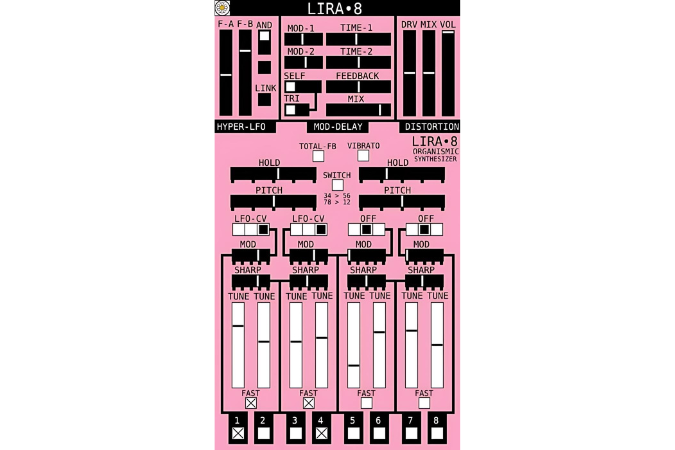
- 8 individually tunable oscillators arranged in 4 pairs and 2 groups, faithfully recreating the Lyra-8 voice architecture
- FM cross-modulation between oscillator pairs with adjustable depth, plus Total FB mode that feeds post-distortion signal back into the LFO for self-evolving textures
- Built-in dual delay, hyper LFO, and distortion section matching the original hardware's signal flow
- MIDI triggering (C1-G1) and full DAW automation of all parameters, adding studio workflow integration the hardware lacks
- Sharp slider morphs oscillators from triangle to square wave, with Pitch and Hold controls per group for continuous drone generation
- Open-source Pure Data core (Camomile-wrapped) with cross-platform support for Windows, macOS, and Linux
Description
LIRA 8 by Mike Moreno DSP is a digital emulation of SOMA Laboratory's Lyra-8, the Russian organismic drone synthesizer known for its unpredictable analog character and touch-sensitive interface. Built in Pure Data and wrapped via Camomile, it recreates the original's 8 tunable oscillators, FM cross-modulation between paired voices, dual delay, hyper LFO, and distortion in a plugin you can automate inside your DAW.
The eight oscillators are divided into four pairs (1-2, 3-4, 5-6, 7-8), then grouped into two banks (1-4 and 5-8) for additional processing. Each voice is triggered by clicking the on-screen sensor pads or sending MIDI notes C1 through G1, and the Sharp slider morphs each oscillator from triangle to square wave.
Total FB mode replaces the LFO with the instrument's own post-distortion signal, turning the entire architecture into an FM feedback loop that produces evolving metallic textures and unpredictable harmonic shifts. Reviewers who own the hardware Lyra-8 note that the plugin captures the overall sound aesthetic convincingly, delivering wobbling drones, shimmering soundscapes, and fizzling FM weirdness.
The Variety of Sound blog, comparing the plugin directly against the hardware on the desk, called it a "real surprise" soundwise and recommended it for sound design and pure inspiration. Reddit users describe it as a great way to explore the Lyra-8 concept without the $600+ price tag, praising the quantize button that makes it more accessible than the hardware.
LIRA 8 is open-source (293 stars on GitHub) and runs on Windows, macOS, and Linux as VST, VST3, AU, and LV2, with a standalone Pure Data version also available. Note that Apple M1 (ARM) is not currently supported.
Video Preview


Frequently Asked Questions
Does LIRA 8 work on Apple Silicon Macs?
Apple M1 and later ARM-based Macs are not currently supported according to the developer's disclaimer. The plugin works on Intel-based Macs running macOS 10.9 or later, and may run under Rosetta 2 translation, though this is not officially confirmed.
How does LIRA 8 compare to the real SOMA Lyra-8 hardware?
Variety of Sound compared the plugin directly against the hardware and found it captures the overall sound aesthetic convincingly, calling it a real surprise. However, the hardware's tactile touch-sensitive interface and analog unpredictability cannot be fully replicated in software. The oscillator tuning controls also lack the fine resolution of the analog originals.
Can LIRA 8 be controlled via MIDI in a DAW?
Yes. The eight sensor pads respond to MIDI notes C1 through G1, and all parameters are accessible via host automation. This gives the plugin a significant workflow advantage over the hardware, which relies solely on manual touch interaction with no MIDI control.
What is Total FB mode and how does it work?
Total FB replaces the LFO modulation source with the instrument's own post-distortion output signal. This creates an FM feedback loop where the synth modulates itself, producing evolving metallic textures, chaotic harmonic shifts, and self-generating drone patterns that continuously change over time.