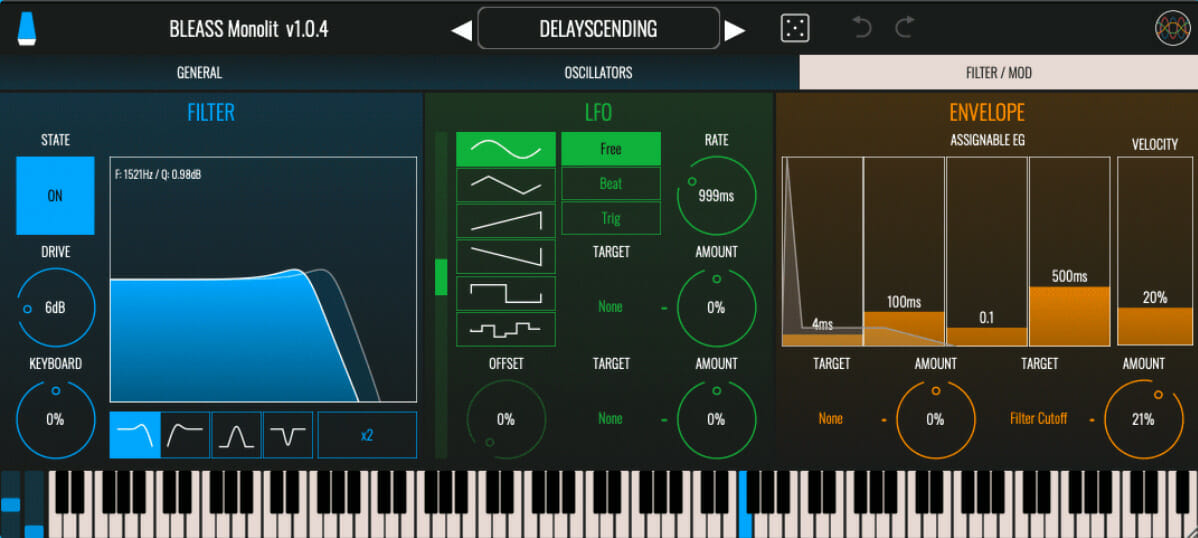
Monolit
Key Features
- Dual oscillator design with four-waveform blending on OSC 1 and continuous waveform morphing on OSC 2
- FM synthesis stage that modulates one or both oscillators for metallic and complex timbres
- Unison engine with up to seven detuned voices for massive leads and layered basses
- Multimode filter (LP, HP, BP, notch) with x2 slope doubling, drive, and keyboard tracking
- Built-in arpeggiator with five modes (normal, up, down, up/down, random) and DAW sync
- Deep modulation routing via LFO, modulation envelope, mod wheel, slide, and aftertouch — each with dual destinations
- Ultra-low CPU footprint allows stacking many instances without taxing your system
Description
Monolit is a monophonic analog-modeled synthesizer from BLEASS, built around a dual-oscillator architecture with an FM stage and up to seven-voice unison. Released to celebrate World Music Day in 2022, it combines the warm analog character of BLEASS Alpha with the expressive modulation routing of BLEASS Omega.
The first oscillator blends four simultaneous waveforms (pulse, triangle, sawtooth, and noise) with adjustable pulse width, while the second oscillator offers a continuously morphable waveform from sine through square. An FM operator can modulate either or both oscillators, opening the door to metallic textures and complex harmonics that go well beyond typical analog emulations.
A multimode filter with low-pass, high-pass, band-pass, and notch modes includes a drive stage and key tracking for adding grit and movement. The built-in arpeggiator syncs to your DAW or runs freely, with five pattern modes and octave range expansion.
Modulation options are unusually deep for a compact monosynth. An LFO with six waveform shapes, a dedicated modulation envelope, and three-source MIDI routing (mod wheel, slide, and aftertouch) each target two simultaneous destinations.
A dice button generates musically tuned random patches for quick inspiration when you need to break out of creative ruts.
The interface uses full-width faders and clear graphical feedback rather than traditional knobs, making it equally responsive to mouse and touchscreen input. BLEASS designed the synth engine for minimal CPU usage, so running multiple instances is practical even on modest hardware.
Video Preview


Frequently Asked Questions
Does Monolit support MPE controllers?
Yes. Monolit responds to MPE slide messages (CC-74) and aftertouch, with each controller routable to two synth parameters simultaneously. This makes it well-suited for expressive performance with MPE-compatible hardware like the ROLI Seaboard or Sensel Morph.
Can Monolit play chords or is it strictly monophonic?
Monolit is a monophonic synthesizer, meaning it plays one note at a time. However, its unison mode stacks up to seven detuned voices on a single note for a much thicker sound. The built-in arpeggiator can also cycle through held notes to create chord-like patterns.
How does the FM synthesis work in Monolit?
Monolit includes a dedicated FM operator with a morphable waveform and octave control. It can modulate the frequency of oscillator 1, oscillator 2, or both simultaneously. This adds harmonic complexity and metallic textures on top of the analog-style oscillators, giving the synth a wider tonal range than a purely subtractive design.
What is the dice button in Monolit?
The dice button randomizes all synth parameters at once, but BLEASS tuned the randomization algorithm to produce musically usable results rather than pure noise. It is a quick way to discover unexpected patches and break out of creative ruts.