
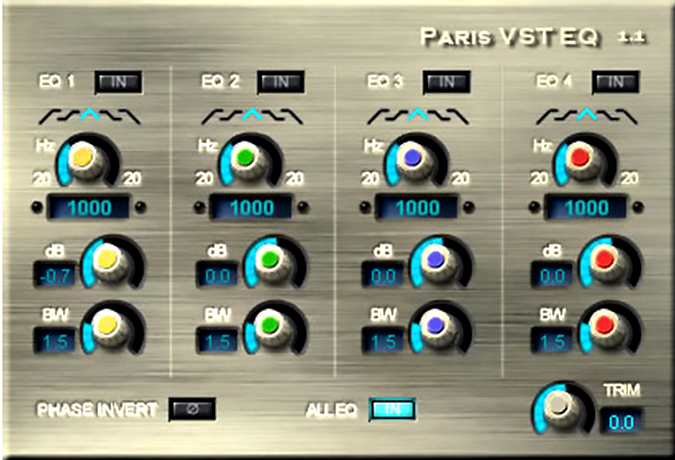
ParisEQ
Key Features
- Four-band stereo parametric EQ based on the E-mu/Ensoniq PARIS hardware algorithm
- Switchable filter types per band: high-pass, high-shelf, peaking, low-shelf, and low-pass
- Built-in soft-limiting and analog-style saturation that responds musically when levels are pushed
- Adjustable bandwidth (Q) in octaves for each band with resonant behavior under high gain settings
- 64-bit internal processing precision with output trim and phase-reverse controls
- Per-band EQ in/out bypass switches for quick A/B comparison of individual adjustments
Description
ParisEQ is a four-band stereo parametric equalizer that recreates the algorithm from the E-mu/Ensoniq PARIS digital audio workstation, a hardware system originally released in 1997 that earned a devoted following among engineers for its unusually musical EQ character. Where most digital EQs aim for transparency, ParisEQ deliberately introduces the colorful behavior of the original PARIS hardware, including soft-limiting, grungy distortion capability, and resonant characteristics under certain gain settings.
The PARIS system was renowned for handling gain staging differently than conventional DAWs, where pushing levels produced tape-like compression and saturation rather than harsh digital clipping. ParisEQ brings that same analog-like response into any Windows DAW as a standard VST plugin.
Each of the four bands offers switchable filter types including high-pass, high-shelf, peaking, low-shelf, and low-pass modes with adjustable bandwidth in octaves. The plugin also provides output trim, phase-reverse, per-band EQ bypass switches, and processes audio at 64-bit internal precision.
ParisEQ excels on bass guitar and vocals where its coloration adds body and presence that cleaner EQs cannot match. On some material it has been favorably compared to more expensive commercial parametric equalizers, though its character makes it better suited to creative tone-shaping than surgical corrective work.
The plugin was developed by Matt Craig and runs on Windows as a 64-bit VST effect. The developer is no longer active, so no further updates or macOS support are expected.
Video Preview

Frequently Asked Questions
How does ParisEQ differ from a standard parametric EQ?
Unlike transparent digital EQs, ParisEQ uses the same algorithm as the E-mu/Ensoniq PARIS hardware system, which introduces deliberate coloration including soft-limiting and harmonic saturation. This makes it behave more like analog hardware, where pushing levels adds warmth and character rather than harsh digital distortion.
What was the original PARIS hardware system?
PARIS (Professional Audio Recording Integrated System) was a DSP-based digital audio workstation released by Ensoniq in 1997 and later continued by E-mu Systems. It was known for its exceptionally musical EQ and a unique gain staging behavior that produced tape-like saturation, earning a devoted following among engineers.
Will ParisEQ receive updates or a macOS version?
No. The developer Matt Craig is no longer active, and the plugin has not been updated since its original release. There are no plans for macOS support or further development. The plugin remains functional on Windows systems with 64-bit VST host compatibility.
What types of material does ParisEQ work best on?
ParisEQ is particularly effective on bass guitar and vocals, where its coloration adds body and presence. It performs well as a creative tone-shaping tool but is less suited for surgical corrective EQ work due to its inherent character and color.


