
Pastel Reverb
Key Features
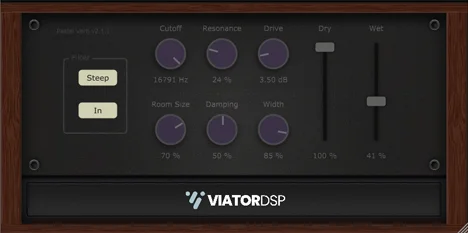
- Shapes a room-style reverb with room size, damping, and width controls.
- Provides separate dry and wet level controls for send-style or insert-style workflows.
- Uses an input ladder low-pass filter to darken and soften the material feeding the reverb.
- Adds cutoff, resonance, and drive controls for tonal filtering and soft-clipped color before the reverb stage.
- Lets you bypass the filter section when a cleaner path and lower CPU use are preferred.
- Switches the filter response between a steeper 24 dB/octave curve and a smoother 12 dB/octave curve.
- Runs as VST3 on Windows and VST3 or AU on macOS.
Description
Pastel Reverb is a compact room-style reverb from Viator DSP that combines room size, damping, width, and independent dry/wet level controls in one deliberately focused effect. Its input ladder filter adds cutoff, resonance, and drive, so it can move from cleaner ambience toward darker, softer, more colored spaces without loading a separate filter.
The filter can be bypassed when it is not needed, and the steep/smooth switch changes its slope between 24 dB per octave and 12 dB per octave. That makes Pastel Reverb a practical choice when a mix needs a controllable sense of room while the top end, stereo spread, and tonal density still need shaping.
It is especially useful on an aux send: the developer specifically recommends that approach for its darker, smoother reverb treatments, while separate dry and wet controls also support serial use. Independent testing characterizes the effect as distinct but unobtrusive, with a clean, reduced-control workflow rather than a deep menu of reverb algorithms.
Frequently Asked Questions
What kind of reverb is Pastel Reverb?
Pastel Reverb is a room-style effect. Room size, damping, and width set the core space, while the input filter changes the tone feeding that space.
Can Pastel Reverb work on an aux send?
Yes. Viator DSP specifically recommends using the filter-based darker treatment on an aux send for parallel processing. Separate dry and wet controls also make it possible to tailor the balance for other routing choices.
What does the ladder filter do?
It removes high frequencies before the reverb, helping create a darker, smoother response. The cutoff, resonance, drive, and two slope options allow more deliberate tonal shaping than a basic tone knob.
Which plugin formats does it provide?
The official product post lists VST3 for Windows and VST3 plus AU for macOS. The developer does not list AAX or additional formats on that product page.


