
Key Features
- Switch between transformer-like Fuzzy and CMOS-style Clanky saturation.
- Shape the low and high frequencies before distortion to change its response.
- Blend the distorted and dry signals with a dedicated Mix control.
- Apply the pre-saturation shaping to the clean path with Dry EQ.
- Invert the wet signal polarity to explore different interactions with the dry bass.
- Use automatic oversampling and a resizable interface with input and output overload indicators.
Description
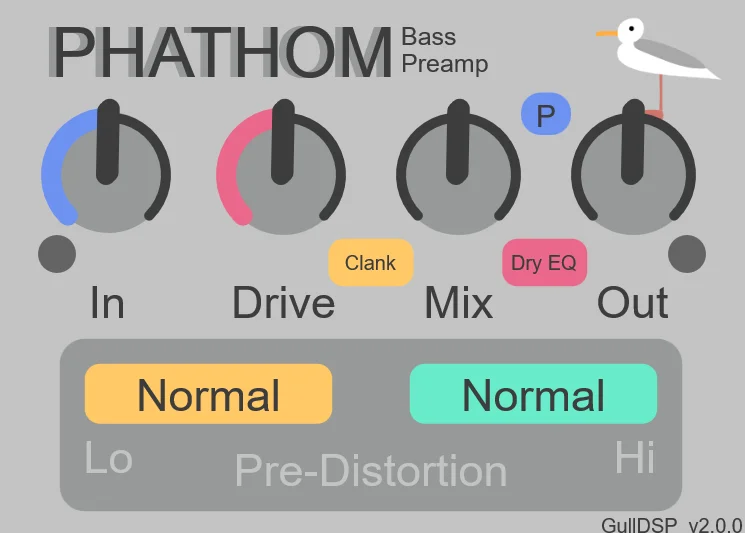
Phathom is a bass guitar preamp and distortion plugin by GullDSP, built for modern fuzzy and growling tones. Its two saturation styles respond to the input signal and give a direct bass track a choice of smoother transformer-like drive or a noisier CMOS-style edge.
Choose Fuzzy for the transformer-style character or Clanky for a sharper, more aggressive sound, then adjust Drive to set how hard the saturation is fed. The Mix control blends the processed signal with the original, making it possible to retain some clean bass alongside the distortion.
Low and high pre-distortion controls change what reaches the saturation stage, so the same drive setting can react differently to the instrument and playing dynamics. Dry EQ applies that pre-saturation shaping to the clean path too, while the polarity switch changes how the wet and dry signals combine.
The saturation uses a stateful hysteresis approach that reacts to current and previous input rather than relying solely on a static curve. Automatic oversampling depends on the host sample rate, and GullDSP describes the processor as zero latency.
Phathom is available as a Windows 64-bit VST3 release, with a resizable interface and input and output overload indicators. It is a focused preamp and distortion stage for bass players and producers who want to shape DI tone inside a compatible host.
Video Preview

Frequently Asked Questions
How do Fuzzy and Clanky differ?
Fuzzy uses a smooth transformer-like saturation model, while Clanky uses a noisier CMOS-style distortion. Switch between them and adjust Drive to find the character that suits the part.
What does the polarity switch do?
It flips the polarity of the distorted signal before it mixes with the dry signal. GullDSP cautions that this can reduce bass frequencies, so judge the result by ear.
What does Dry EQ change?
Dry EQ applies the pre-saturation signal shaping to the dry input as well. The developer suggests it can be useful when feeding other distortion effects.
How does oversampling work?
The developer says host rates below 80 kHz use 4x oversampling, while rates from 80 kHz to 160 kHz use 2x. GullDSP describes the plugin as zero latency regardless of oversampling status.


