
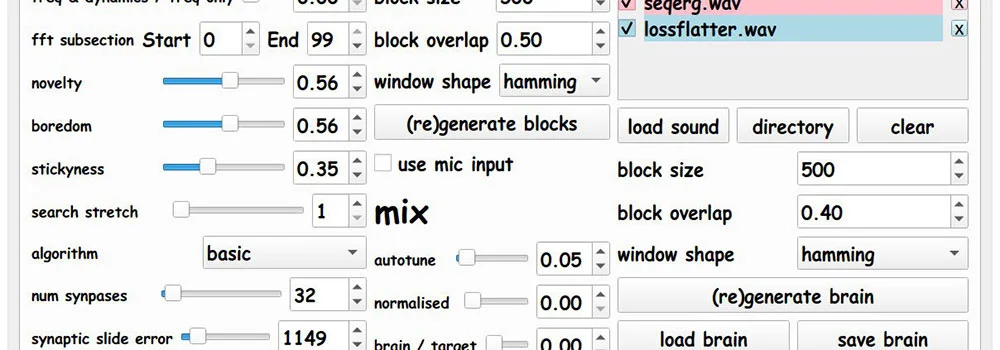
Samplebrain
Key Features
- Concatenative synthesis engine — matches blocks from a loaded sample library to reconstruct a target sound in real time
- Brain file system — large sample libraries can be pre-analyzed and saved, then reloaded instantly for future sessions
- Adjustable block size and similarity matching — control how closely each output block resembles the target, from faithful to wildly abstract
- Supports WAV, AIFF, AIFC, AU, SND, FastTracker XI, and FLAC audio file formats for both brain and target inputs
- OSC control support — configurable ports let you trigger and modulate Samplebrain from external hardware or software
- Cross-platform standalone — runs natively on Windows, macOS (Intel and Apple Silicon via Rosetta), and Linux (Flathub / Ubuntu PPA)
- Open source under GPL v2 — full source code available on GitLab for modification and building from scratch
Description
Samplebrain is a one-of-a-kind audio tool created by programmer Dave Griffiths (Then Try This) in collaboration with Aphex Twin — the electronic music icon also known as Richard James. Aphex Twin envisioned a giant brain that could ingest thousands of samples and reconstruct any target sound from them.
At its core, Samplebrain uses concatenative synthesis rather than conventional granular processing. It chops a library of audio files — the "brain" — into short segments called blocks, then analyzes a target sound and rebuilds it in real time using the closest-matching blocks.
The result sounds like your target audio rendered through someone else's sonic vocabulary: glitchy, textural, and unpredictably alive. Parameters control block size, similarity thresholds, and playback behavior, with larger libraries producing richer and stranger results.
Processed brain files can be saved and reloaded instantly, so the slow analysis step only happens once. Samplebrain runs as a standalone application on Windows, macOS (Intel and Apple Silicon), and Linux — it is not a VST or AU plugin.
The tool supports OSC control for integration with other software and is released under the GPL v2 open source license. Its full source code is available on GitLab.
Video Preview


Frequently Asked Questions
How does Samplebrain actually work — is it granular synthesis?
It is not granular synthesis in the traditional sense. Samplebrain uses concatenative synthesis: it analyzes both the brain (your source sample library) and a target sound, chops them both into blocks, then plays back whichever brain block most closely matches each section of the target. The result is a real-time audio mosaic — your target sound reinterpreted through the timbre and texture of completely different samples.
Is Samplebrain CPU-intensive?
The initial brain-generation step can be slow with large sample libraries, since it must analyze every block for similarity data. However, this only happens once — you can save the processed brain to a file and reload it instantly on future sessions. Real-time playback after brain generation is generally manageable, even on older hardware.
Does Samplebrain work on Linux?
Yes, Linux is officially supported. You can install it via Flathub or, on Ubuntu-based distributions, via the official PPA (ppa:thentrythis/samplebrain). Source code is also available on GitLab for building on other distributions.
Is Samplebrain a VST/AU plugin I can use inside my DAW?
No — Samplebrain is a standalone application only. It does not exist in VST, VST3, AU, or AAX formats and cannot be loaded as a plugin inside a DAW. You run it separately, record its output, and bring that audio into your DAW.
Can I use Samplebrain outputs in commercial music?
Samplebrain itself is licensed under GPL v2, which governs the software — not the audio it generates. The audio you produce is entirely your own. However, any samples you load into the brain are subject to their own licensing terms, so you remain responsible for the source material you use.


