
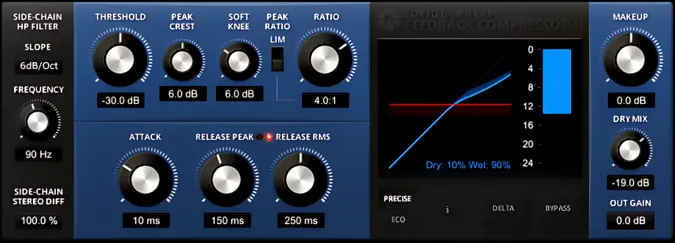
TDR Feedback Compressor II
Key Features
- Feedback compression topology that analyzes the output signal for inherently musical, self-adjusting gain reduction
- Dedicated stereo bus and program compression with extremely low distortion and near-transparent operation
- Highly flexible control scheme with detailed attack, release, and compression behavior parameters beyond standard compressor designs
- Capable of both subtle mix bus glue and more assertive dynamic shaping on drums, vocals, and instrument groups
- Pure digital design philosophy prioritizing sonic accuracy over analog emulation or circuit modeling
- Zero-cost professional-grade dynamics processing that competes with paid bus compressors in listening tests
Description
TDR Feedback Compressor II is a high-fidelity stereo dynamics processor from Tokyo Dawn Labs built around a feedback compression topology. Unlike most modern compressors that analyze the input signal (feed-forward), this plugin monitors the output to control gain reduction, producing inherently musical and unobtrusive compression that handles complex program material with ease.
Originally designed for mix bus duties, the compressor excels at gluing tracks together while preserving the dynamic integrity of the source. Users consistently praise its ability to add weight and cohesion to full mixes, with several engineers comparing its tonal heft to hardware units that cost hundreds of dollars.
The control scheme goes well beyond standard threshold-and-ratio parameters, offering detailed adjustment of compression behavior including flexible attack and release shaping. This depth of control allows precise tuning from subtle bus glue to more assertive dynamic shaping on individual tracks, drums, and instrument groups.
Tokyo Dawn Labs explicitly designed this as a pure digital processor rather than an analog emulation, focusing on extremely low distortion and near-invisible compression artifacts. The result is a compressor that tightens and enhances without imposing a particular analog color on the signal.
Note that TDR Feedback Compressor II is now a legacy product, with TDR Kotelnikov serving as its actively maintained successor. The plugin remains available for download but is no longer receiving updates, and stability in Logic X is a known issue.
Video Preview


Frequently Asked Questions
What is the difference between TDR Feedback Compressor II and TDR Kotelnikov?
TDR Kotelnikov is the actively maintained successor to Feedback Compressor II. While both share the feedback compression topology and a visually similar interface, Kotelnikov has been improved significantly under the hood with better algorithms and broader compatibility. Tokyo Dawn Labs recommends using Kotelnikov for new projects.
What does feedback compression topology mean in practice?
Most compressors use a feed-forward design, analyzing the input signal to determine gain reduction. Feedback topology instead monitors the output signal, which creates a self-correcting loop. This produces smoother, more musical compression that responds organically to complex material, making it particularly well-suited to mix bus applications.
Is TDR Feedback Compressor II still worth using as a legacy product?
It remains a capable compressor that many engineers continue to use, particularly on older sessions. However, since it is no longer receiving updates and has a known stability issue in Logic X, new users are better served by downloading TDR Kotelnikov instead, which offers improved sound quality and full modern OS support.
Can TDR Feedback Compressor II be used on individual tracks or only the mix bus?
While it was designed primarily for stereo bus compression, it works equally well on individual tracks, drum groups, and instrument subgroups. Its flexible control scheme allows you to dial in settings ranging from subtle glue to more aggressive dynamic control depending on the source material.


