
ToneShaper


Key Features
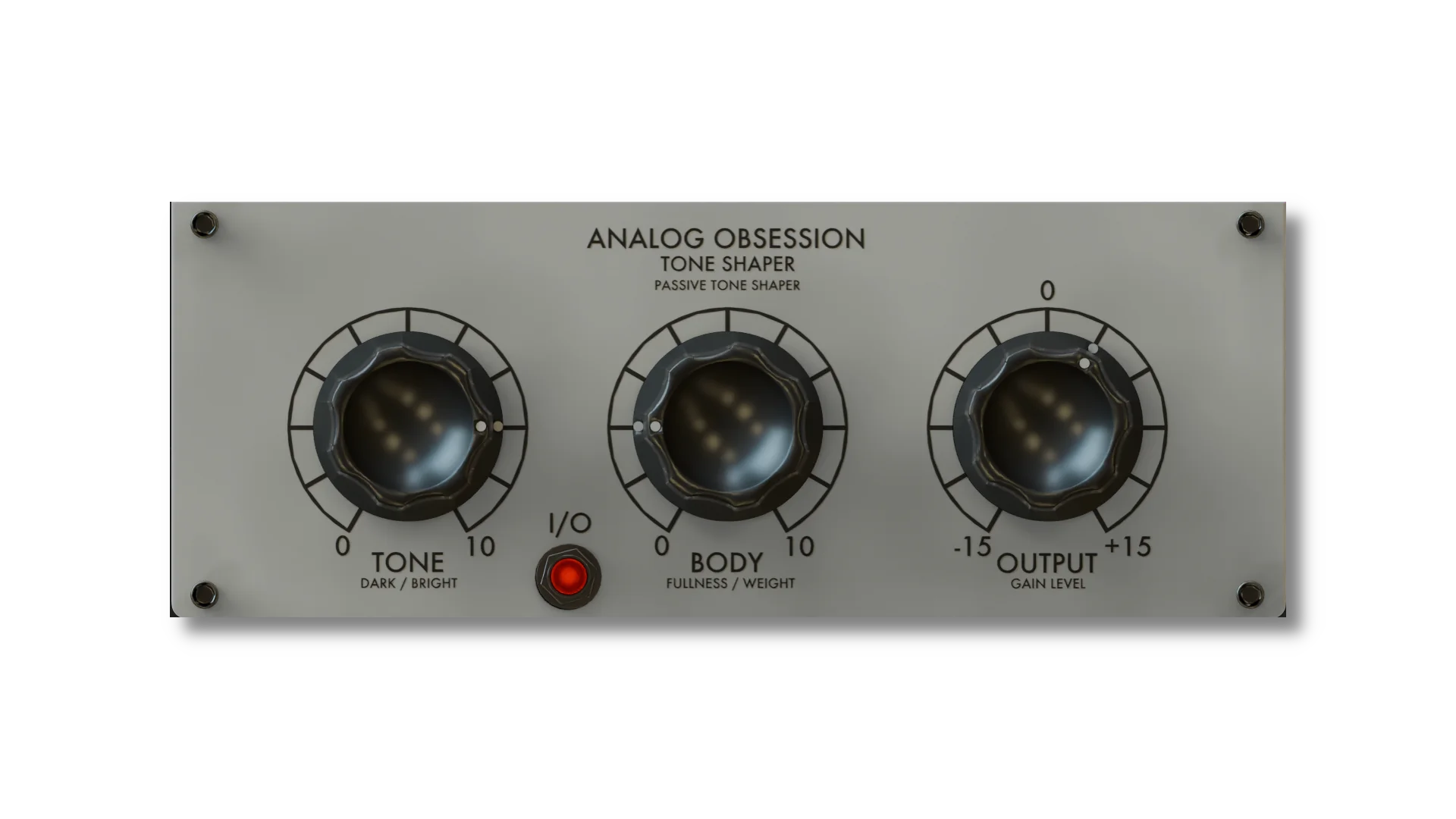
- TONE uses a high-shelf-like curve to steer sources toward a darker or brighter balance.
- BODY reshapes low-mid and midrange weight for more or less fullness.
- A clean output control compensates for the level loss inherent in the passive-style design.
- Avoids non-linear stages, so its tonal changes are not designed to add saturation or harmonic color.
- I/O bypass supports quick before-and-after level-matched listening.
- Resizable interface scales from 50% to 200% for different session layouts.
- Version 1.0 supports VST3, AU, and AAX variants across the listed macOS and Windows builds.
Description
ToneShaper is Analog Obsession's compact passive tone-control plug-in for broad brightness and body adjustments without deliberate saturation or other non-linear coloration. Its TONE control works like an unusually shaped high shelf to make a source darker or brighter, while BODY reshapes the low-mid and midrange weight.
Because the passive-style circuit loses substantial level, the plug-in includes a clean output stage to compensate. That makes it a practical choice when a vocal, drum bus, guitar, bass, or full mix needs a quick tonal nudge rather than a detailed corrective EQ session.
The deliberately short control set keeps the workflow focused: TONE, BODY, OUTPUT, and I/O bypass. The interface can be resized from 50% to 200%, letting the same simple processor fit compact laptop sessions and larger mix screens.
ToneShaper version 1.0 is supplied for current macOS and Windows systems through Analog Obsession's official Patreon post. It is an EQ/tone shaper, not a saturation plug-in or JSFX release; the discovery headline's wording does not match the developer's product description or listed formats.
Frequently Asked Questions
Is ToneShaper a saturation plug-in?
No. Analog Obsession describes ToneShaper as a fully passive tone-control design with no non-linear elements intended to color the signal. It changes frequency balance rather than adding a dedicated saturation stage.
What do the TONE and BODY controls change?
TONE is an odd-shaped, high-shelf-like control for making a source darker or brighter. BODY shapes the low-mid and mid frequencies to add or remove perceived fullness.
Why does ToneShaper include an output control?
Passive circuit designs lose level, and the developer estimates about 20 dB of gain loss in this case. ToneShaper's clean OUTPUT control covers that loss so you can compare tonal moves at a more useful level.
How does the resizable interface remember its size?
The developer says a duplicated instance remembers the current GUI size, while a newly loaded instance opens at its default size. To make a preferred size recur for new instances, resize it before setting knobs and save that state as the DAW's default preset.


